Washing machine leak water damage: what to do first
How to stop a washer, dishwasher or refrigerator leak, find the source, dry the floor and cabinets, and know when to call for help. A 24/7 line can connect you with a local Florida company.
A washing machine, dishwasher or refrigerator leak usually starts small and out of sight: a cracked supply hose behind the washer, a dishwasher drain connection under the sink, an ice maker line behind the fridge. Because these appliances sit on the floor next to cabinets and walls, water can spread under flooring and into baseboards before you notice it. This guide covers the first safe steps, how to find the source, which checks you can do yourself, and when to call a plumber, an appliance technician or a water damage restoration company.
Safety first
- Water and electricity: washers, dishwashers and refrigerators are plugged in, often near the floor. Don't reach for a plug or an outlet while standing in water. If you can reach the breaker panel from a dry floor, switch off that circuit first; if you can't, leave the power to an electrician. The Electrical Safety Foundation advises not touching electrical equipment that has been wet and having it checked by a qualified professional before using it again (ESFI).
- Washer and dishwasher water isn't clean water. Restoration guidelines class "discharge from dishwashers or washing machines" as Category 2 (gray) water, meaning it can carry enough contamination to make people sick (Northern Arizona University, Water Damage Restoration Guideline). Wear gloves, keep children and pets away, and wash up afterwards. Water from a supply hose that burst before reaching the machine starts out clean, but it picks up dirt from floors and carpets.
- If the drain backs up with water from the toilet or the floor drain at the same time, that's a sewer line problem, not an appliance leak. Stop using water and see our sewage backup guide.
What to do right now
- Stop the cycle and cut the power safely. Pause or switch off the machine at its controls, then unplug it or turn off its breaker once you're on a dry floor.
- Close the water supply. Washers have hot and cold valves on the wall behind them; dishwashers usually have a valve under the kitchen sink; refrigerator lines often have a small valve under the sink or behind the fridge. If you can't find or close one, use the main shut-off. Our shut-off valve guide shows where to look in a house or condo.
- Take photos and video of the water, the appliance, the hose or fitting that failed, and the floor and cabinets around it before you clean up. Florida's Department of Financial Services says to document damage before and after repairs and to report a claim promptly (Florida DFS claim guide). Keep the failed hose or part.
- Remove standing water and start drying. Towels and a wet/dry vacuum handle a small spill. Pull out the toe-kick panel or move the appliance only if it's safe, so air reaches underneath. EPA cleanup guidance is built around drying within 24 to 48 hours to prevent mold growth (EPA mold remediation guide, chapter 4).
- Check the next room and the floor below. Look at the other side of the wall, inside base cabinets and, in a two-story home or condo, the ceiling underneath. In a condo, tell the association and the neighbor below in writing.
Washing machine leaks: find the source
Where the water shows up, and when, points to the cause. Samsung's support guidance groups washer leaks by location: the door, the hoses and tap connections, the drain hose, the drain filter cap and the detergent drawer, plus overloading, an uneven floor and high water pressure (Samsung support, updated June 26, 2023). Your own model's manual is the final word.
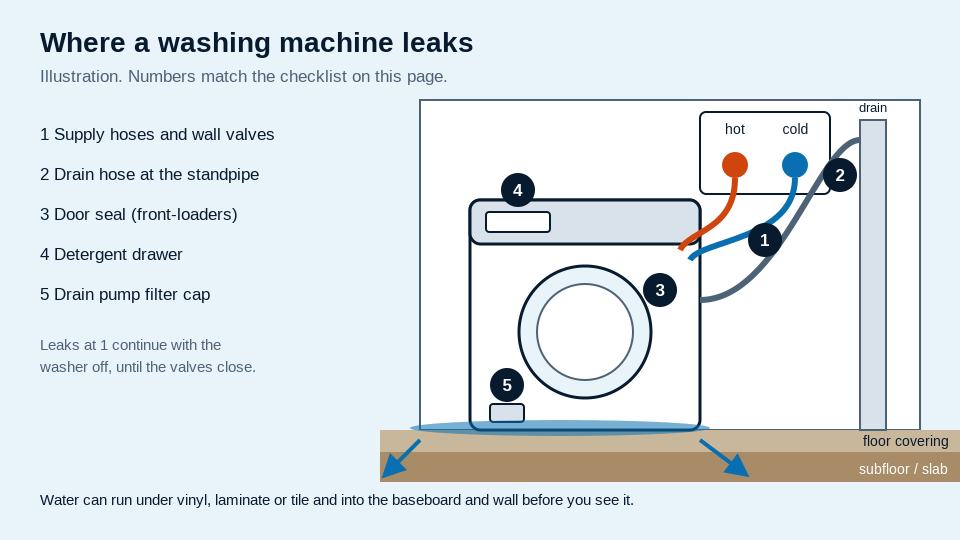
Illustration, not a photo of a real home. Numbers match the list below.
- Water behind the washer, even when it isn't running (1): a supply hose or its connection at the wall valve or the machine. A hose under constant pressure keeps leaking until the valves are closed, so treat this as the urgent one.
- Water during the drain or spin cycle, near the wall (2): the drain hose has slipped out of the standpipe, is kinked or split, or the standpipe is overflowing because the house drain is slow.
- Water in front of the door on a front-loader (3): lint, hair or a sock caught in the door seal, or a torn seal.
- Drips under the detergent drawer (4): the drawer wasn't closed fully, or too much detergent is foaming over.
- A puddle at the bottom front (5): the drain pump filter cap wasn't closed properly after cleaning, or the filter is clogged.
- Water under the machine with no clear source: an internal hose, the pump or the tub seal. That's a job for an appliance technician.
Dishwasher leaks
- Water in front of the door: a worn door gasket, dishes blocking the door, or the wrong detergent causing suds.
- Water under the sink: the supply connection or the drain hose connection at the disposal or sink tailpiece. The drain hose should rise in a "high loop" under the counter, or connect through an air gap at the sink; manufacturers require one or the other to stop dirty water flowing back into the dishwasher, and a missing loop can leave water sitting in the hose (Reuben Saltzman, Structure Tech, July 20, 2010).
- Water creeping out from under the dishwasher, or swollen flooring in front of it: a leak underneath. Consumers' Checkbook suggests checking underneath right after a cycle by removing the trim strip or access panel below the door, and notes that a failed shut-off (fill) valve can keep filling the tub until water spills out (Consumers' Checkbook, last updated June 2026). If the dishwasher keeps filling with the door open or the power off, close its valve and call for service.
Refrigerator and ice maker leaks
An ice maker or water dispenser line is pressurized all the time, so a small crack can leak day and night. A consumer tip sheet from the Connecticut Insurance Department, citing the Insurance Institute for Business & Home Safety, says 73% of losses involving an ice maker were caused by failure of the supply line hose, and 10% involved new refrigerators and were linked to improper installation. It suggests replacing a kinked hose and leaving a 3 to 4 inch gap behind the refrigerator so the line doesn't get crimped ("Quick Tips to Prevent Water Damage," CT Insurance Department, undated).
Whirlpool's support page names two common sources of water on the floor: the water filter (wrong, incompatible or overdue filters, or one not fully locked in) and the water connection, which can leak at any joint if it was installed incorrectly or is cracked (Whirlpool product help, modified September 3, 2026). Check around the filter housing, then pull the fridge out carefully and look along the line to the wall or sink valve.
What you can do yourself, and what needs a professional
Reasonable for a homeowner
- Closing appliance valves or the main water supply.
- Cleaning a front-loader door seal or the drain filter as the manual describes, and closing the cap and drawer fully.
- Re-seating a drain hose in the standpipe and securing it so it can't pop out.
- Replacing worn washer supply hoses with reinforced braided stainless steel ones (with the valves closed and the machine unplugged).
- Mopping, running fans and moving belongings out of the wet area.
Call a professional for
- Leaks inside the appliance (pump, tub seal, internal hoses, fill valve): an appliance repair technician.
- Valves that won't close, leaking wall valves, a slow or overflowing standpipe, or a new water line to the fridge: a licensed plumber. Florida's Department of Business and Professional Regulation says consumers should always verify licenses before hiring contractors, online through the DBPR site or by phone at (850) 487-1395 (DBPR consumer advisory, March 15, 2016).
- Water under flooring, inside cabinets or in the wall: a restoration company with moisture meters and drying equipment. EPA guidance says wallboard may be dried in place only if there is no obvious swelling and the seams are intact; otherwise it should be removed and replaced (EPA, table 1). See water extraction, wet hardwood floor drying and structural drying.
- A musty smell or visible mold after a slow leak: see our mold remediation guide.
- Water through the ceiling below a laundry room or kitchen: see ceiling water damage.
Common mistakes
- Drying only what you can see. Vinyl plank, laminate and tile can hide water underneath, and cabinet bases made of particleboard soak it up. If flooring is cupping or cabinet bottoms are swelling, the water went further than the puddle.
- Running the machine again "to see where it leaks" without someone watching and a hand on the valves.
- Relying on a drip pan alone. A pan under the washer catches drips, but Consumers' Checkbook notes it won't handle a burst hose or a failed valve.
- Throwing away the failed hose or part. Keep it, photographed, until any claim is settled.
- Waiting to see if a slow leak stops. Many Florida homeowners policies exclude "constant or repeated" leakage over 14 days or more in some form (Marshall Dennehey, June 2018).
Prevent the next one
- Washer hoses: inspect them every 6 months for cracks, kinks or blisters, which most often appear near the connections; manufacturers recommend replacing them every 5 years, and the tip sheet suggests reinforced braided stainless steel (CT Insurance Department). Consumers' Checkbook reports insurers recommend every three to five years.
- When you're away: close the washer valves before a trip (Consumers' Checkbook).
- Leak detectors and automatic shut-off valves on washer and dishwasher supply lines can catch slow leaks early (Consumers' Checkbook).
- Refrigerators: keep the 3 to 4 inch gap behind the fridge, use the filter your model calls for and change it on schedule.
When to stop troubleshooting
Stop and call for help if water keeps coming with the valves closed, you can't reach the power safely, water has reached a wall, cabinets or the floor below, flooring is lifting or cupping, or you smell sewage. Every hour adds to the drying work.
Insurance notes for Florida
Coverage depends on your policy and on whether the leak was sudden (a hose that burst) or went on for a long time (a slow drip under the dishwasher). Report the damage promptly, keep receipts for emergency drying, keep the failed part and your photos. Florida law also sets deadlines for giving notice of a claim. Our Florida water damage insurance guide explains those deadlines, the 14-day seepage exclusion and how condo associations and unit owners usually split responsibility. We can't tell you whether a claim will be paid.
What affects the cost
We don't quote prices, and the independent companies you reach set their own. The main factors are how far the water spread, the type of flooring (vinyl and laminate over a slab dry differently from hardwood or carpet), whether cabinets, drywall or the room below are wet, how long it was wet, whether the water is gray water from a drain, and whether mold has started. Our cost calculator gives a rough range.
Washing machine and appliance leak questions
How often should washer hoses be replaced?
Washing machine manufacturers recommend replacing supply hoses every 5 years, and an insurance department tip sheet suggests inspecting them every 6 months for cracks, kinks or blisters. Reinforced braided stainless steel hoses are a common upgrade.
Why is my washing machine leaking from the bottom?
Common causes are a door seal with lint or hair caught in it, a drain filter cap that isn't closed fully, a slipped or split drain hose, or an internal hose or pump. If there is no visible source, close the valves, unplug the washer and call an appliance technician.
Is water from a washing machine leak dangerous?
Water drained from a washer or dishwasher is classed as Category 2 (gray) water, which can carry enough contamination to make people sick. Wear gloves, keep children and pets away and dry or replace soaked materials quickly.
Why is there water under my dishwasher?
Check the door gasket, the supply and drain connections under the sink, and the drain hose's high loop or air gap. A failed fill valve can keep filling the tub until water spills out. Close the dishwasher's valve and call for service if water keeps coming.
Why is my refrigerator leaking water on the floor?
On fridges with an ice maker or dispenser, the supply line is a common culprit: one insurance tip sheet says 73% of ice maker losses came from supply line failure. A filter that is the wrong type, overdue or not locked in can also drip.
Can wet cabinets be saved?
Sometimes. Particleboard often swells and must be replaced; solid wood may dry out.
Does homeowners insurance cover a washing machine leak in Florida?
It depends on your policy and on whether the leak was sudden, like a burst hose, or went on for a long time. Many Florida policies exclude leakage that continued for 14 days or more. Report damage quickly and keep photos and the failed part. See our insurance guide.
How does this service work?
We're a referral service. Your call goes to an independent provider serving your area, sometimes through a call partner, and we may be paid for the referral. You agree on the work and price directly with the provider.
Who will come to my home?
An independent, local water damage restoration or plumbing company that serves your area. Ask them about their Florida licensing, insurance and certifications (such as IICRC) when you talk.
Do you do the restoration work yourselves?
No. We don't employ crews or own equipment. We connect you with independent local companies.
Where we connect Florida homeowners
Independent companies in our network serve many parts of the state, including South Florida, Tampa Bay, Central Florida, Northeast Florida, Southwest Florida, Space and Treasure Coast, Florida Panhandle, Florida Keys. Coverage depends on your ZIP code.
- Water damage help in Miami
- Water damage help in Tampa
- Water damage help in Orlando
- Water damage help in Jacksonville
- Water damage help in Fort Lauderdale
- Water damage help in St. Petersburg
- Water damage help in Naples
- Water damage help in Fort Myers
- Water damage help in Sarasota
- Water damage help in West Palm Beach
- Water damage help in Tallahassee
- Water damage help in Pensacola
Appliance leak cleanup questions
How often should washer hoses be replaced?
Many manufacturers suggest every 5 years. Braided stainless steel hoses are less likely to burst.
Can wet cabinets be saved?
Sometimes. Particleboard often swells and must be replaced; solid wood may dry out.
How does this service work?
We're a referral service. Your call goes to an independent provider serving your area, sometimes through a call partner, and we may be paid for the referral. You agree on the work and price directly with the provider.
Who will come to my home?
An independent, local water damage restoration or plumbing company that serves your area. Ask them about their Florida licensing, insurance and certifications (such as IICRC) when you talk.
Do you do the restoration work yourselves?
No. We don't employ crews or own equipment. We connect you with independent local companies.
Sources were checked on October 19, 2026. Last updated October 19, 2026.
Get appliance leak cleanup help now.
Call now. We'll connect you with a local Florida company that can help.