Emergency water extraction in Florida
How standing water gets pumped and extracted out of a Florida home, what you can safely do first, and when carpet and pad can be saved. A 24/7 line can connect you with a local company.
Emergency water extraction (also called emergency water removal) means getting standing water off your floors and out of carpet and pad as fast as possible after a leak or flood. The more water comes out at the start, the shorter the drying time and the less you lose to swelling, warping and mold. This guide covers the safe first steps, what a company actually does, when carpet and pad can be saved, how Florida homes and condos complicate things, and what to know about insurance before anyone starts work.
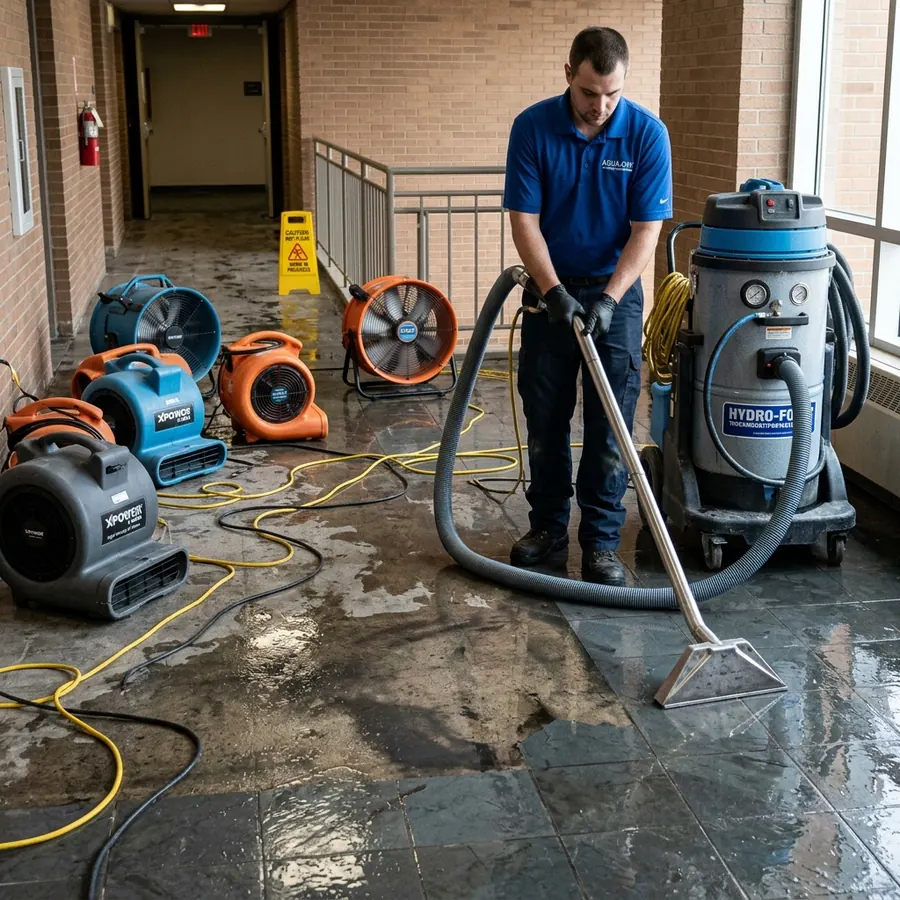
Before anyone touches the water
- Assume standing water can be live. Standing water can carry an electric current even if it looks calm. Don't walk into a flooded room until the power is off at the main breaker or fuse box, and don't turn back on circuits that were under water (City of St. Petersburg). If you can't reach the panel from a dry spot, call an electrician or your utility.
- Don't touch wet appliances that are still plugged in (CPSC).
- Keep gasoline engines outside. Gas-powered pumps, pressure washers and generators make carbon monoxide. NIOSH warns never to run machinery with gasoline engines inside any building, and the EPA and CPSC say to run portable generators outdoors, at least 20 feet from the house (NIOSH, EPA).
- Treat sewage and outside floodwater as contaminated. Keep children and pets away and leave the cleanup to a professional. See sewage backup cleanup or flood damage restoration.
- Stay out from under a sagging ceiling. Wet drywall is heavy. More in our ceiling water damage guide.
Quick answer: what to do in the first hour
- Stop the water. Close the valve at the fixture or the main shut-off. Our shut-off valve guide shows where to find it in a house or condo.
- Make it safe using the checks above.
- Photograph and video everything before anything is moved or thrown out: the water line on walls, the source, damaged items and serial numbers. Florida's Division of Consumer Services advises taking photos of the damage before and after repairs and keeping all receipts (Homeowner Claims Bill of Rights, May 2025).
- Get the water out the same day. A wet-dry vacuum can handle a small, clean spill. For anything more, call a restoration company. The EPA notes that mold can grow on wood, drywall, carpet and furniture that stay wet for more than 24 hours (EPA).
- Move what you can off wet floors: rugs, furniture, boxes, electronics. Put foil or wood blocks under furniture legs that have to stay.
- Tell your insurer and, in a condo, your association and the unit below.
Small spill or extraction job?
You can usually handle it yourself when the water is clean (a supply line, a sink, a water heater drain), the area is small, it has been wet for hours rather than days, and the electricity is safe. NC State Extension suggests a shop vacuum (if there is electricity) plus dry towels and blankets to blot up clean water, then pulling up and propping wet carpet so it can dry, and cutting away wet padding (NC State Extension, rev. March 27, 2024).
Call a company when any of these apply:
- Water covers more than one room, or has run under walls, cabinets or into the unit below.
- The water came from a toilet, sewer line, washing machine drain or outside.
- Carpet pad is saturated across a large area. NC State says a large saturated area of pad is impossible to clean and dry thoroughly.
- The floors or walls are still wet after a day.
- You smell mustiness or see mold, or anyone in the home has asthma, allergies or a weak immune system.
- You can't make the area electrically safe.
What emergency water extraction involves
Every company works a little differently, but a typical visit follows this order:
- Confirm the source is stopped and the area is safe. If a pipe or fixture failed, a licensed plumber repairs it; see burst pipes and plumbing leaks.
- Judge the type of water (clean, gray or black). This decides what can be saved. The categories are explained in our water damage restoration guide.
- Pump out deep water with submersible pumps where water is standing more than an inch or two.
- Extract from flooring. Truck-mounted or portable extractors pull water out of carpet, pad and hard floors. Weighted or stand-on extraction tools press water out of carpet and pad that will be kept.
- Find the hidden water. Moisture meters and often a thermal camera show where water ran under tile, laminate, baseboards and cabinets.
- Remove what can't be saved, such as saturated pad, and list and photograph it before it leaves.
- Set up drying right away: dehumidifiers and air movers, with readings taken until materials are dry. That stage is covered in structural drying and wet hardwood floor drying.
Can the carpet and pad be saved?
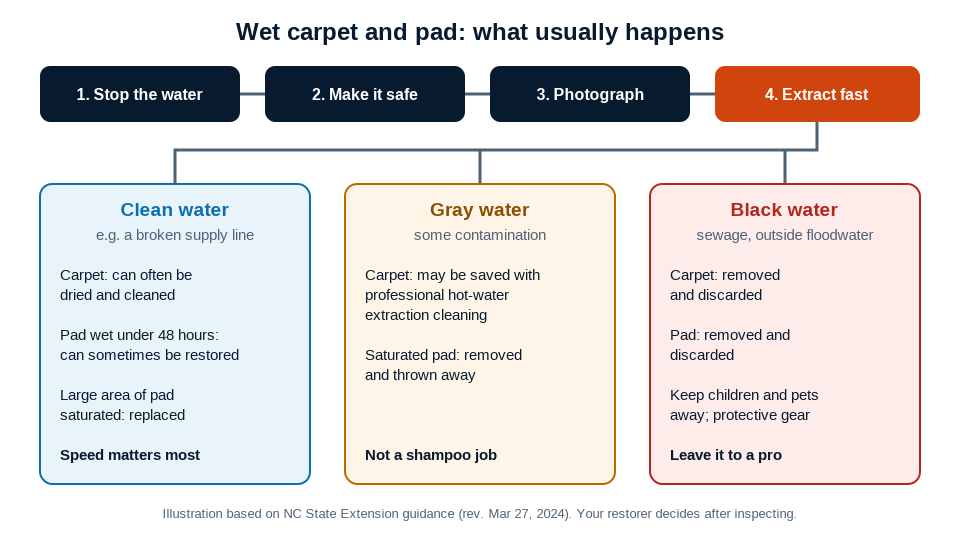
Illustration, not a photo of a real home. Based on NC State Extension guidance; the company inspecting your floor makes the final call.
It depends mostly on what kind of water it was and how long it sat. NC State Extension's guidance (rev. March 27, 2024):
- Clean water: carpet pad can be restored if it has been wet from clean water for less than 48 hours. Carpet glued down without pad can be cleaned in place. Drying should start within 24 hours.
- Gray water: carpet may be saved with professional hot-water extraction cleaning; NC State says absorbent compounds, bonnet, dry foam or shampoo cleaning are not adequate. Saturated pad is removed and thrown away.
- Black water (sewage, outside floodwater): carpet and pad saturated with it are removed and discarded.
- Subfloor: plywood can usually be dried; particleboard tends to swell and break down if it stays wet for a few days. Don't put new pad or carpet down until the subfloor is completely dry.
Water that starts clean doesn't always stay clean. If it sits for days in a warm house, ask the company whether the category has changed.
Why Florida homes need extra attention
- Slab floors and tile. Many Florida houses sit on a concrete slab, often with tile, laminate or engineered wood on top. Water that looks gone from the surface can sit under the flooring and wick up into the bottom of drywall and baseboards. A moisture meter, not a dry-looking floor, tells you when extraction is done.
- Heat and humidity. Humid air slows natural drying, which makes the 24-hour mold warning above matter more here. Keep windows closed and the AC running (if it is safe to use) unless the restorer says otherwise.
- Condos and apartments. Water travels down. Tell the building manager and the unit below right away, and photograph your unit before the association's contractor arrives. Who pays for which part depends on your condo documents and policies; see our insurance guide.
- AC and water heater closets. Many leaks start where an AC drain line overflows or a water heater leaks; the water often spreads under walls into the next room.
Insurance: what to do before extraction starts
- Document first, then mitigate. Florida's Homeowner Claims Bill of Rights says to make and document emergency repairs needed to prevent further damage, keep receipts, and photograph the damage before and after repairs. Ask the company for its photos, moisture readings and drying log.
- Call your insurer before you sign a repair contract. The same guide advises contacting your insurance company before entering into a contract for repairs, reading any contract that could leave you paying out of pocket, confirming the contractor is licensed in Florida, and asking for proof of insurance.
- Check your policy for emergency-service limits. Some Florida policies cap what they pay for emergency water removal unless you use the insurer's own program. For example, Citizens announced in 2018 a $3,000 limit on reasonable emergency measures for non-weather water losses, unless the policyholder used its Emergency Water Removal Services program (Citizens bulletin, 2018). Policies change, so read your current declarations or ask your agent.
- Assignment of benefits. For residential property policies issued on or after January 1, 2023, Florida law bars assigning post-loss benefits to a contractor (s. 627.7152(13), Fla. Stat.). Be wary of any form that asks you to sign over your claim.
- Deadlines. Florida gives one year after the date of loss to report a new or reopened claim (s. 627.70132), but report as soon as you can. Sudden leaks and slow, long-running leaks are often treated differently; see our insurance guide.
Questions to ask the company on the phone
- Is the person coming trained in water damage restoration (for example, IICRC-certified), and is the company licensed and insured in Florida?
- Will you take photos and moisture readings before you start, and give me a copy?
- What type of water do you think this is, and what will that mean for my carpet, pad and drywall?
- Will you need to remove anything? Will you list and photograph it first?
- How will you price the job, and will I get a written estimate before work beyond the emergency extraction begins?
- Will you work with my insurance company, and what am I signing?
What affects the cost of water extraction
We don't publish prices because they vary by company, area and job. These are the factors that usually move an estimate up or down:
- How much water there is, and how many rooms and floor types it reached
- The type of water (clean, gray or black) and the protective gear and disposal it requires
- How long it sat before extraction started
- Carpet and pad versus tile, laminate or hardwood, and whether any flooring has to come up
- Access, for example a high-rise condo where hoses from a truck-mounted unit can't reach
- Night, weekend or holiday call-outs
- How many days of drying equipment and monitoring are needed afterward
For a rough range for the whole job, try the cost calculator.
Where we connect Florida homeowners
Independent companies may be available across Florida, including South Florida, Tampa Bay, Central Florida, Northeast Florida, Southwest Florida, Space and Treasure Coast, Florida Panhandle and the Florida Keys. Availability depends on your ZIP code.
- Water damage help in Miami
- Water damage help in Tampa
- Water damage help in Orlando
- Water damage help in Jacksonville
- Water damage help in Fort Lauderdale
- Water damage help in St. Petersburg
- Water damage help in Naples
- Water damage help in Fort Myers
- Water damage help in Sarasota
- Water damage help in West Palm Beach
- Water damage help in Tallahassee
- Water damage help in Pensacola
Emergency water extraction questions
Can I extract the water myself?
For a small spill of clean water, yes: a wet-dry vacuum (only if the electricity is safe) plus towels, then lift and prop wet carpet and cut away wet pad. For water across several rooms, contaminated water, saturated pad or floors still wet after a day, a restoration company's extractors remove far more water and shorten drying.
How fast should standing water be removed?
The same day if you can. The EPA notes that mold can grow on wood, drywall, carpet and furniture that stay wet for more than 24 hours, and NC State Extension says carpet drying should start within 24 hours.
Can wet carpet and pad be saved?
It depends on the water. NC State Extension says pad wet from clean water for less than 48 hours can be restored, but a large saturated area of pad can't be dried thoroughly. Pad soaked with gray or black water is removed, and carpet soaked with sewage or outside floodwater is discarded.
What is the difference between water extraction and drying?
Extraction physically removes liquid water with pumps and extractors. Drying comes next: dehumidifiers and air movers pull the remaining moisture out of floors, walls and framing, with readings taken until the materials are dry. Good extraction makes the drying stage shorter.
Is it safe to use a gas-powered pump indoors?
No. Gasoline engines produce carbon monoxide. NIOSH warns never to run machinery with gasoline engines inside any building, and the EPA and CPSC say portable generators belong outdoors, at least 20 feet from the house.
Will insurance pay for emergency water extraction?
It depends on your policy and the cause. Document the damage first, call your insurer before signing a repair contract, and check your policy for limits on emergency water removal. Some Florida policies cap these costs unless you use the insurer's own program.
Should I sign an assignment of benefits for extraction?
For residential property policies issued on or after January 1, 2023, Florida law bars assigning post-loss benefits to a contractor (s. 627.7152(13), Fla. Stat.). Read anything you're asked to sign, and ask your insurer if you're unsure.
How does this service work?
We're a referral service. Your call goes to an independent provider serving your area, sometimes through a call partner, and we may be paid for the referral. You agree on the work and price directly with the provider.
Who will come to my home?
An independent, local water damage restoration or plumbing company that serves your area. Ask them about their Florida licensing, insurance and certifications (such as IICRC) when you talk.
Do you do the restoration work yourselves?
No. We don't employ crews or own equipment. We connect you with independent local companies.
Sources
- EPA, Flood Cleanup to Protect Indoor Air and Your Health (updated March 18, 2026)
- NC State Extension, Water-Damaged Carpets and Rugs (June 11, 2014; revised March 27, 2024)
- City of St. Petersburg, Flooding (undated page, checked November 2, 2026)
- CPSC flood safety release (February 5, 2024)
- NIOSH, carbon monoxide from gasoline pressure washers indoors (Publication 93-117, May 10, 1993)
- Florida Department of Financial Services, Homeowner Claims Bill of Rights (May 2025)
- Citizens Property Insurance, non-weather water loss limits (2018; may be outdated)
- s. 627.7152, Fla. Stat. and s. 627.70132, Fla. Stat.
Sources were checked on November 2, 2026. Last updated November 2, 2026. This page is general information, not legal or insurance advice.
Get emergency water extraction help now.
Call now. We'll connect you with a local Florida company that can help.