Wet hardwood floor? Drying and next steps in Florida
What to do in the first hours, what cupping and buckling mean, and when a floor can be saved. A 24/7 line connects you with an independent local company.
Wet wood floors swell, cup and sometimes buckle. Whether a floor can be saved depends on how fast the water source is stopped, how wet the boards and the subfloor or slab got, and whether anyone sands too early. This guide covers what you can safely do in the first hours, what the warning signs mean, how drying is checked with moisture readings, and the Florida insurance points to know.
Quick answer
- Stop the water first. Close the fixture valve or the main shut-off (how to find your shut-off), and keep it closed until the leak is fixed.
- Get standing water off the floor now. Blot or wet-vac it; don't leave towels or rugs sitting on the boards.
- Run dehumidification and air movement. Keep the AC running, close windows on humid days, and use fans across the floor. EPA's cleanup table says to use caution with heat on hardwood.
- Photograph everything before anything is removed, including the leak source and close-ups of cupped boards.
- Don't sand or refinish yet. Cupped boards can flatten as they dry. Sanding before moisture readings say the wood is ready can leave a floor that crowns later.
Safety first
- Water near outlets, power strips or floor-level appliances: don't walk through it to unplug things. Switch the circuit off at the breaker panel only if you can reach it from a dry spot; otherwise wait for an electrician.
- Sewage, a toilet overflow or outdoor flood water: treat it as contaminated. Wood and the materials under it that soaked up that water usually can't simply be dried in place. See the sewage backup guide.
- Older homes: EPA lists resilient floor tiles (vinyl, asphalt, rubber), sheet-vinyl backing and floor-tile adhesives among materials that can contain asbestos, and says not to sand, scrape or try to level asbestos flooring or its backing. If old tile or black adhesive sits under or next to the wood, have it tested before anyone grinds or scrapes.
- Soft, sagging or springy spots on a raised (non-slab) floor: stay off them and let a professional check the subfloor and framing.
Cupping, crowning and buckling: what each sign means
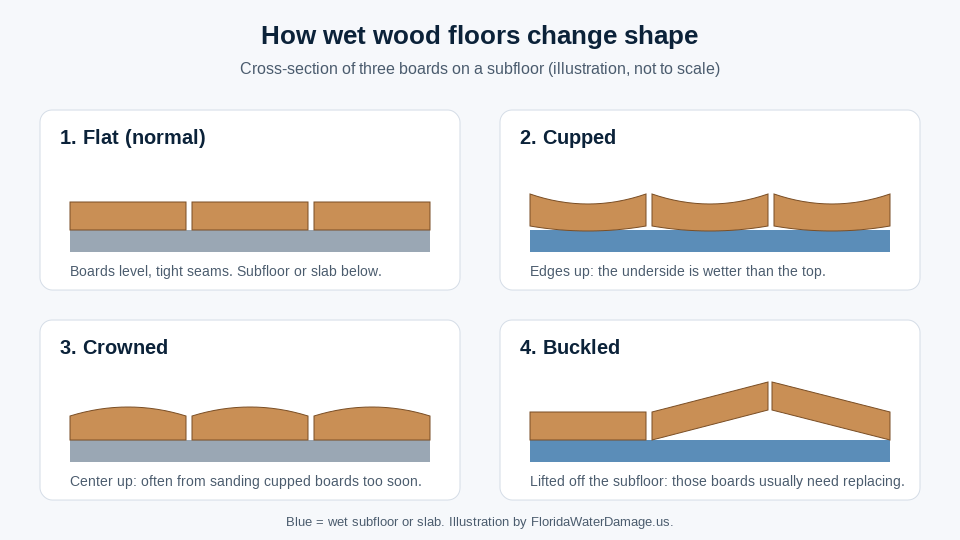
Illustration, not a photo of a real floor.
- Cupping (edges higher than the centers): the underside of the boards is wetter than the top. It is the most common first sign after a leak. According to the National Wood Flooring Association's Hardwood Floors magazine, minor water damage often fades or disappears as the floor dries out.
- Crowning (centers higher than the edges): after water damage, this often means a cupped floor was sanded flat before it had fully dried. As the extra moisture leaves the wood, the top shrinks and the board humps. Hardwood Floors magazine (2025) and a Wood Floor Business inspection case (2020) both describe this.
- Buckling (boards lifted off the subfloor): the most serious sign. NWFA's technical director writes that once a floor has buckled, its nails, staples or adhesive no longer hold, and the buckled flooring should be replaced in that area.
- Gaps, dark stains along seams, or a musty smell: signs that water sat between or under boards. Dark stains and odors can also point to mold, which is a separate problem from the boards' shape (see mold remediation in Florida).
What you can safely do in the first 24 to 48 hours
EPA's guidance on clean-water damage is built around responding within 24 to 48 hours to prevent mold growth, and it notes that mold can grow even on materials dried within 48 hours. For wood surfaces, EPA says to remove moisture immediately and dry with dehumidifiers, gentle heat and fans, with caution when applying heat to hardwood floors.
- Stop the source. A supply-line, water heater or AC drain leak keeps feeding the floor until it is shut off. For an AC overflow, see the AC drain guide.
- Remove surface water with a wet-vac or towels. Lift area rugs and pads off the wood so they don't hold water against it.
- Move furniture off wet areas and put foil or plastic under legs that must stay, to avoid stains.
- Dry the air. Keep the AC on and doors to the wet room closed if you have a dehumidifier running there. In Florida's humidity, opening windows can slow drying rather than speed it.
- Use fans across the floor, not just pointed at the ceiling. Don't use high heat on hardwood.
- Check under cabinets and baseboards. Water travels under flooring and into wall bottoms. If drywall is wet, the walls need drying too (see structural drying).
- Write down what you see each day: where the cupping is, whether it is getting better or worse, and any smell.
How professionals check and dry a wood floor
Drying a wood floor is judged by measurements, not by how it looks or feels. In NWFA's published guidance, a restorer or flooring inspector will typically:
- Map the moisture with a pinless meter across the floor and compare it with dry wood in an unaffected room.
- Take readings at depth with insulated pin or hammer-probe meters, in the flooring and in the subfloor. A floor can read dry at the surface and still be wet deeper in the board.
- Set a target for the wood, not just the room. NWFA's guidance is to dry to within 2 percentage points of the moisture content the floor is expected to have in normal use, based on local temperature and humidity, and it warns that drying standards used by restoration companies can be higher than wood flooring requires.
- Dry the floor system: dehumidifiers (desiccant or low-grain refrigerant units are named as effective), air movement, gentle heat, and sometimes vacuum drying mats placed on the boards to pull water from the wood.
- Re-measure until the target is met, then wait for the boards to settle before deciding on sanding, repair or replacement.
Florida floors on concrete slabs
Many Florida homes are built on concrete slabs, so wood floors here are often engineered boards glued or floated over concrete rather than solid boards nailed to plywood. That changes the job:
- The slab dries slowly. NWFA's guidance notes that concrete itself usually isn't harmed by water, but adhesives and sealers can slow its drying, and it has to be dried to the flooring and adhesive makers' limits before new flooring goes down.
- Testing the slab: flooring makers set relative-humidity limits for concrete, and moisture-meter maker Wagner (2019, updated 2026) recommends documenting slab humidity with the ASTM F2170 in-place test before wood is installed. Ask whoever reinstalls the floor which test and which limit they are using.
- Glue-down engineered boards can come loose from the adhesive when water gets under them; Wagner lists debonding among moisture failures. NWFA's guidance is that once fasteners or adhesive stop holding, that flooring should be replaced.
- Floating floors (click-together engineered wood or laminate) can trap water underneath on top of the slab and any underlayment. Taking up some boards is often the only way to dry what is under them.
- Raised wood-frame homes and older houses have plywood, plank or OSB subfloors. A Mississippi State Extension sheet, adapted from UF/IFAS, says soaked plywood often delaminates, and a fully delaminated subfloor should be replaced.
Laminate and vinyl plank are different
"Water resistant" isn't the same as waterproof. One laminate warranty sold at a major home store, for example, says the product resists spills wiped up within 24 hours but does not cover flooding, and excludes mold from prolonged moisture. With vinyl plank, the planks may survive, but the slab or subfloor and underlayment underneath still need to be dried and checked; EPA's table says to make sure the underflooring is dry. NWFA's article also notes that "waterproof" floors can still end up replaced after a flood.
Repair or replace?
- Often saved: mild cupping from a short, clean-water leak that was dried promptly. Many floors flatten as they dry, and some need only a light sand and refinish once readings confirm they are ready.
- Partial replacement: buckled boards, boards that came loose from the adhesive, and stained or swollen boards in one area. Matching species, width, stain and sheen can be hard, which is why insurance matching rules matter (below).
- Usually replaced: floors soaked with sewage or flood water, swollen laminate, and floors over a delaminated or rotted subfloor.
Insurance notes for wood floors in Florida
Coverage depends on your policy, so read the water damage section and any endorsements, or ask your agent. Points that come up often:
- Sudden vs. long-term leaks. Many policies exclude "constant or repeated seepage or leakage" over 14 days or more. In Hicks v. American Integrity (2018), a Florida appeals court found that wording ambiguous about the first 13 days of a leak, as Berger Singerman explains. A floor that cupped slowly under a dishwasher may be treated differently from one soaked by a burst supply line.
- Matching. Florida's matching statute (s. 626.9744) says that when replaced items don't match in quality, color or size, the insurer must make reasonable repairs or replacements in adjoining areas, unless the policy provides otherwise. Claims Journal reported in 2023 that at least eight Florida insurers had endorsements approved that cap matching payments at 1% of the dwelling limit, and that Citizens has policyholders pay for matching work first and then seek reimbursement. Check whether your policy has one of these endorsements before agreeing to a patch repair.
- Deadlines. Florida law (s. 627.70132) requires notice of a property insurance claim within one year after the date of loss, and of a supplemental claim within 18 months.
- Mitigate and document. Policies generally expect you to stop further damage, such as shutting off the water and starting drying. Keep photos, moisture readings, the drying log and receipts. Don't throw away removed boards until the adjuster has seen them or says you can. More in our Florida water damage insurance guide.
What affects the cost
We don't publish prices, because they vary by home and by company. These are the things that change the bill:
- How long water sat on and under the floor, and how many rooms it reached.
- Solid vs. engineered wood, glue-down vs. nailed vs. floating installation.
- Slab or wood subfloor, and whether the subfloor needs replacing.
- Drying time and equipment, including drying mats and the number of moisture checks.
- Whether boards can be refinished or must be replaced, and whether matching boards are still made.
- Testing for asbestos in older flooring or adhesive, and any mold work.
The cost calculator can give you a rough starting range.
Common mistakes
- Sanding a cupped floor flat before moisture readings say it is ready, then watching it crown.
- Judging dryness by touch or by how flat the boards look.
- Drying only the room air while water stays trapped under a floating floor or in the slab.
- Using high heat on hardwood.
- Leaving wet rugs, pads or towels on the boards.
- Scraping old tile or black adhesive without an asbestos test.
- Throwing away boards before the insurer has documented them.
When to call a professional
Call a water damage company when water has been on the floor for more than a few hours, when boards are buckling or coming loose, when water got under a floating floor or into walls, when the water is dirty, or when you smell mold. Call a licensed plumber for the leak itself. A restorer with moisture meters and drying equipment can tell you whether the floor is drying or needs to come up, and their readings help with an insurance claim.
Where we connect Florida homeowners
Independent companies in our network serve many parts of the state, including South Florida, Tampa Bay, Central Florida, Northeast Florida, Southwest Florida, Space and Treasure Coast, Florida Panhandle, Florida Keys. Coverage depends on your ZIP code.
- Water damage help in Miami
- Water damage help in Tampa
- Water damage help in Orlando
- Water damage help in Jacksonville
- Water damage help in Fort Lauderdale
- Water damage help in St. Petersburg
- Water damage help in Naples
- Water damage help in Fort Myers
- Water damage help in Sarasota
- Water damage help in West Palm Beach
- Water damage help in Tallahassee
- Water damage help in Pensacola
Wet wood floor questions
Can a wet hardwood floor be saved?
Often, if the water was clean, the leak was stopped quickly and drying started within a day or two. Mild cupping frequently fades as the boards dry. Buckled boards, boards that came loose from the adhesive, and floors soaked by sewage or flood water usually need replacing.
How long does a wet wood floor take to dry?
There is no fixed time. It depends on how much water got in, the wood, the subfloor or slab, and the drying equipment. A Mississippi State Extension sheet adapted from UF/IFAS warns that fully drying a floor before repairs can take weeks or even months. Moisture readings, not the calendar, tell you when it is dry.
Will cupped boards flatten again?
Many do once the wood and the subfloor dry, because cupping means the underside is wetter than the top. Wait for moisture readings to confirm the floor is ready before sanding; sanding too early can make the boards crown later.
Why is my floor crowning after it was sanded?
Crowning after water damage usually means the boards were sanded flat while still wetter at the bottom than the top. As that moisture leaves, the top of each board humps. Hardwood Floors magazine and Wood Floor Business both describe this.
Should I pull up the boards myself?
Not before photographing the damage and talking to your insurer, and not if the home is older and there may be asbestos in tile or adhesive under the wood. A restorer can often dry a floor in place with mats and dehumidifiers, and only removes boards where readings or buckling show it is needed.
Does homeowners insurance pay for wet hardwood floors in Florida?
It depends on the policy and the cause. Sudden water from a burst pipe or appliance line is treated differently from a slow leak; many policies exclude seepage over 14 days or more. Florida's matching statute (s. 626.9744) can require repairs in adjoining areas when new boards don't match, unless your policy limits that, and some insurers' endorsements cap matching at 1% of the dwelling limit.
How does this service work?
We're a referral service. Your call goes to an independent provider serving your area, sometimes through a call partner, and we may be paid for the referral. You agree on the work and price directly with the provider.
Who will come to my home?
An independent, local water damage restoration or plumbing company that serves your area. Ask them about their Florida licensing, insurance and certifications (such as IICRC) when you talk.
Do you do the restoration work yourselves?
No. We don't employ crews or own equipment. We connect you with independent local companies.
Related guides
- Burst pipe: first steps and drying
- Washing machine and dishwasher leaks
- Slab leak signs and testing
- Emergency water extraction
- Water damage emergency steps
Sources
- U.S. EPA, Table 1: Water Damage, Cleanup and Mold Prevention (Mold Remediation in Schools and Commercial Buildings; page last updated January 14, 2026): epa.gov (PDF)
- Brett Miller (NWFA), Assessing and Addressing Water Damage, Hardwood Floors magazine (December 2, 2019): hardwoodfloorsmag.com
- Libby Johnston, Hardwood Hints: Measuring Moisture on a Cupped Floor, Hardwood Floors magazine (October 27, 2025): hardwoodfloorsmag.com
- Blake Nelson and Roy Reichow, First the Floor Cupped. Then it Crowned. Why?, Wood Floor Business (November 18, 2020): woodfloorbusiness.com
- Mississippi State University Extension, Disaster Relief: Home Cleanup and Renovation for Floors, IS1702 (undated; adapted from UF/IFAS): extension.msstate.edu (PDF)
- Wagner Meters, Engineered Flooring Installation on Concrete (May 7, 2019, updated October 26, 2026): wagnermeters.com
- U.S. EPA Region 2, Post-Disaster Renovations and Asbestos for Homeowners and Workers (November 2012): archive.epa.gov (PDF)
- Laminate flooring residential warranty (product document hosted by Lowe's, undated): pdf.lowes.com (PDF)
- Florida Statutes s. 626.9744 (2008 text on the Florida Senate site): flsenate.gov
- Jim Sams, Fla. Insurers Imposing New Limits on Amounts Spent to Match Appearance, Claims Journal (October 23, 2023): claimsjournal.com
- Florida Statutes s. 627.70132 (2025): flsenate.gov
- Berger Singerman, Hicks v. American Integrity (February 28, 2018): bergersingerman.com
Sources were checked on November 9, 2026. Last updated November 9, 2026. This page is general information, not legal or insurance advice.
Get hardwood floor drying help now.
Call now. We'll connect you with a local Florida company that can help.