Ceiling water damage: find the source and stop it
How to tell a bathroom, pipe, AC or roof leak apart, what's safe to check yourself, and when to call for help. A 24/7 line can connect you with a local company.
A brown ring, a bubble in the paint or a drip from a light fixture means water is getting above your ceiling. In Florida homes the source is often a bathroom upstairs, an AC unit in the attic or a closet, a supply pipe, or the roof. This guide shows how to tell them apart, which checks are safe to do yourself, and when to stop and call a plumber or a restoration company.
Safety first
- Sagging or bulging ceiling: keep everyone and everything out from under it. Wet drywall is heavy and can come down without warning. Don't stand under it to poke or drain it.
- Water near a light, fan or outlet: don't touch the fixture or its switch. The Electrical Safety Foundation advises never touching electrical equipment that has been wet and having it checked by a qualified professional before it's used again (ESFI). If you can reach your breaker panel while standing on a dry floor, switching off that circuit is a reasonable step; if not, leave it to an electrician.
- Older homes: asbestos may be present in textured paint and in patching compounds used on wall and ceiling joints; that use was banned in 1977 ("Asbestos in Your Home" booklet, hosted by the City of Tallahassee). The EPA says that if in doubt, treat a material as if it contains asbestos and leave it alone, and don't sand, scrape or drill it (EPA, archived January 2025). Don't cut out an old textured ceiling yourself.
What to do right now
- Clear the area under the wet spot and put down a bucket and towels.
- Stop using the water upstairs (tub, shower, toilet, sink) until you know the source. If the drip continues with nothing running, close the fixture valves or the main shut-off; our shut-off valve guide shows where to find them in a house or condo.
- If an AC unit sits above or near the stain, switch the system off at the thermostat; a blocked condensate drain is a common cause in Florida. See our AC drain overflow guide.
- Take photos and video of the ceiling, the room above and anything damaged before cleanup. Florida's Department of Financial Services says to document damage before and after repairs and report the claim promptly (Florida DFS claim guide).
- Start drying quickly. EPA cleanup guidance is built around responding within 24 to 48 hours to avoid mold growth (EPA mold remediation guide, chapter 4). If the ceiling is soaked or sagging, a water extraction and structural drying company is usually needed.
Match the stain to the likely source
When and where the water shows up is your main clue. Water can also run along joists, pipes or ductwork before it soaks through, so a stain is not always directly under the leak.
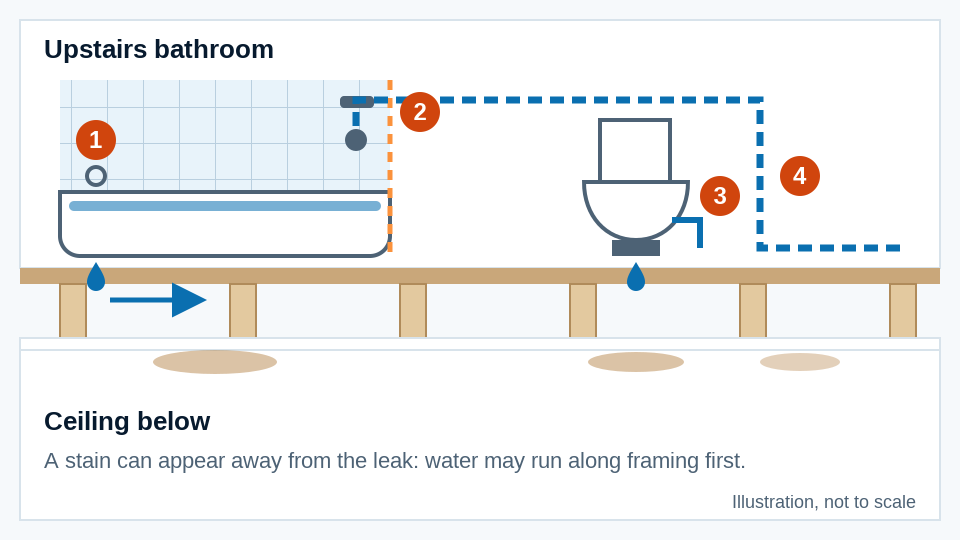
Illustration, not a photo of a real home. Numbers match the list below.
- Only after a bath, with water at the overflow level (1): the tub's overflow or drain gasket.
- Only during or after showers (2): water escaping past the curtain or door, failed caulk or grout, or, in a tiled shower, the shower pan under the tile.
- Under the toilet, after flushing (3): the wax seal under the toilet or the supply line. A toilet that rocks is a warning sign.
- All the time, even with nothing running (4): a pressurized supply pipe or valve. This one keeps leaking until the water is shut off, so treat it as urgent.
- Near an AC vent, return or air handler, worse in hot, humid weather: condensate from the AC. See the AC drain overflow guide.
- After rain, near exterior walls or on a top floor: the roof or flashing. See roof leak water damage.
Step by step: find a bathroom leak above the ceiling
Do one test at a time, with the ceiling as dry as it gets between tests and someone watching the spot below. Running everything at once tells you there is a leak, not where it is. Stop at once if the ceiling starts to sag.
- Check whether water is moving when nothing is on. Turn off every faucet and appliance and note the reading on your water meter. EPA WaterSense guidance (published by the City of Palm Bay) says that if the reading changes after two hours with no water in use, you probably have a leak (Detect and Chase Down Leaks). A changing meter plus a ceiling stain that grows with nothing running points to a supply pipe: call a plumber.
- Check the toilet. Look for water around the base after flushing and whether the toilet rocks. A few drops of food coloring in the tank that show up in the bowl within about 10 minutes means the flapper leaks (EPA WaterSense, via City of Palm Bay); that wastes water but runs into the bowl, so it isn't what stains a ceiling. Water at the base is the one to worry about.
- Test the shower walls and door. Home inspector Reuben Saltzman describes aiming the shower head at the corner where the wall meets the door or curtain line, running it for a few minutes, then checking below (Star Tribune, February 9, 2012). If the ceiling gets wet only now, the joint or caulk is the likely culprit.
- Test the tub. Fill the tub up to the overflow and watch below, then drain it and watch again. The same article notes that plastic drains sometimes leak only under a person's weight as the floor flexes, so a test with an empty tub can miss them.
- Leave a tiled shower floor to a pro. Inspectors test a tiled shower pan by plugging the drain and holding about 2 inches of water in it, and leaks can take a long time to show (Star Tribune). A plumber can run that test with proper drain plugs and knows when to stop before more water reaches the ceiling.
What you can do yourself, and what needs a professional
Reasonable for a homeowner
- Shutting off fixture valves or the main water supply.
- Moving belongings, catching drips and running fans in the room below.
- The observation and one-at-a-time tests above.
- Replacing worn caulk along the tub or shower edge once the source is confirmed and the area is dry.
Call a professional for
- A sagging ceiling or water coming through a light fixture.
- Leaks inside walls or floors, toilet seals, drains and supply lines: a licensed plumber. Ask for their Florida license number.
- Wet drywall, insulation or framing: a restoration company with moisture meters and drying equipment. EPA guidance says wallboard may be dried in place only if there is no obvious swelling and the seams are intact; otherwise it should be removed and replaced, and ceiling tiles should be discarded and replaced (EPA, table 1).
- Visible mold or a musty smell after a leak: see our mold remediation guide.
- A leak from the unit above in a condo or apartment: tell the association or landlord in writing as well as calling the neighbor.
Common mistakes
- Painting over the stain before the source is fixed and the area is completely dry. The stain comes back, and the leak keeps going out of sight.
- Caulking over cracked shower tile. The home inspector cited above says that isn't an acceptable fix for a leaking tiled pan; the pan has to be redone.
- Waiting to see if it stops. Many Florida homeowners policies exclude "constant or repeated" leakage over 14 days or more in some form (Marshall Dennehey, June 2018), so a slow leak you knew about can become a coverage problem.
- Throwing out damaged items before they're photographed (unless they're a health risk).
When to stop troubleshooting
Stop and call for help if the ceiling sags, water reaches a light fixture or outlet, the stain keeps spreading with the water off, you smell sewage, or you can't find the source after the tests above. At that point every hour adds to the drying work.
Insurance notes for Florida
Coverage depends on your policy and on whether the leak was sudden or went on for a long time. Report the damage promptly, keep receipts for emergency repairs, and keep your photos. Florida law sets deadlines for giving notice of a claim. Our Florida water damage insurance guide covers those deadlines, the 14-day seepage exclusion and how condo associations and owners usually split responsibility. We can't tell you whether a claim will be paid.
What affects the cost
We don't quote prices, and the independent companies you reach set their own. The main factors are how much of the ceiling is wet, whether insulation or framing is affected, how long it was wet, whether the leak source needs a plumber, whether mold has started, and texture or paint matching. Our cost calculator gives a rough range.
Ceiling water damage questions
Can a stained ceiling just be painted?
Only once the source is fixed and the area is fully dry. Use a stain-blocking primer first. If the drywall is swollen or the seams have opened, it usually needs to be replaced, not painted.
Is a sagging ceiling an emergency?
Yes. It can collapse. Keep everyone clear, don't stand under it, and call for help.
How can I tell if my bathtub is leaking through the ceiling?
Use the tub on its own with nothing else running: fill it to the overflow and watch the ceiling below, then drain it and watch again. If the stain gets wet only during that test, the overflow or drain is the likely source. A plumber can confirm it.
Why does my ceiling leak only when someone showers?
Usually water is getting past the shower door or curtain, through failed caulk or grout, or, in a tiled shower, through the shower pan under the tile. Testing the walls and the floor separately narrows it down.
The ceiling is wet under the upstairs toilet. What is it?
Most often the wax seal under the toilet or the supply line. Look for water around the base after flushing and check whether the toilet rocks. Stop using that toilet and call a plumber.
Does homeowners insurance cover a ceiling leak from a bathroom?
It depends on your policy and on whether the leak was sudden or long-running. Many Florida policies exclude leaks that continued for 14 days or more, so report damage quickly and keep photos. See our insurance guide for details.
Do I have to replace wet drywall in the ceiling?
Not always. EPA guidance says wallboard may be dried in place if there is no obvious swelling and the seams are intact; otherwise remove and replace it. Ceiling tiles should be replaced.
How does this service work?
We're a referral service. Your call goes to an independent provider serving your area, sometimes through a call partner, and we may be paid for the referral. You agree on the work and price directly with the provider.
Who will come to my home?
An independent, local water damage restoration or plumbing company that serves your area. Ask them about their Florida licensing, insurance and certifications (such as IICRC) when you talk.
Do you do the restoration work yourselves?
No. We don't employ crews or own equipment. We connect you with independent local companies.
Where we connect Florida homeowners
Independent companies in our network serve many parts of the state, including South Florida, Tampa Bay, Central Florida, Northeast Florida, Southwest Florida, Space and Treasure Coast, Florida Panhandle, Florida Keys. Coverage depends on your ZIP code.
- Water damage help in Miami
- Water damage help in Tampa
- Water damage help in Orlando
- Water damage help in Jacksonville
- Water damage help in Fort Lauderdale
- Water damage help in St. Petersburg
- Water damage help in Naples
- Water damage help in Fort Myers
- Water damage help in Sarasota
- Water damage help in West Palm Beach
- Water damage help in Tallahassee
- Water damage help in Pensacola
Sources were checked on October 19, 2026. Last updated October 19, 2026.
Get ceiling water damage help now.
Call now. We'll connect you with a local Florida company that can help.