Slab leak in Florida? Signs, testing and what to do
How to check for a leak under a concrete slab, how it gets found and fixed, and what insurance may ask. A 24/7 line to reach a local company.
A slab leak is a leak in a water or drain line that runs under or inside the concrete slab a house sits on. Many Florida homes are built slab-on-grade, so the pipes are out of sight and a slow leak can soak flooring, baseboards and walls before anyone sees water. This guide shows the signs to look for, a simple water meter test you can do yourself, how the leak is usually found and repaired, and what Florida homeowners should know about insurance. If water is already spreading, you can call our 24/7 line to be connected with an independent local company.
Quick answer
- Suspect a slab leak? Turn off all water use and watch the leak indicator on your water meter. If it moves, water is leaving the system somewhere.
- If floors are wet or warm, close the main shut-off valve and keep it closed until a plumber has checked the lines (how to find your shut-off).
- Don't break the concrete yourself. Have a licensed plumber pinpoint the leak first; many repairs avoid opening the floor.
- Photograph everything before cleanup and tell your insurer promptly.
- Start drying wet materials quickly. EPA guidance is built around responding to water damage within 24 to 48 hours to limit mold.
Safety first
- Water near outlets, cords or a floor-level appliance: don't walk through it to unplug things. Switch off the circuit at the breaker panel only if you can reach it from somewhere dry, or wait for an electrician.
- A hot spot on the floor: if the hot-water line is leaking, the water can be very hot. Don't pry up tile or flooring to look.
- Sewage smell, or water coming up through a floor drain or tub: that points to a drain line, not the supply line. Treat the water as contaminated and keep children and pets away. See the sewage backup guide.
- Cracked or lifting tile, a sagging ceiling below a second-floor line, or a musty smell: stop investigating and get a professional. Damage you can see often means more you can't.
Signs of a slab leak
None of these signs proves a slab leak on its own. Together, and with the meter test below, they tell you whether to call a plumber.
- A water bill that jumps without a change in use. Compare it with the same month last year. Then do the meter test.
- The meter's leak indicator moves with everything turned off. This is the most useful home check (steps below).
- A warm or hot spot on a tile or wood floor. This can point to a leak on the hot-water line under the slab.
- Damp carpet, cupped wood or vinyl, or loose tile with no plumbing fixture nearby.
- The sound of running water when no tap, toilet or appliance is running.
- Musty smell or mold at the bottom of walls and baseboards.
- Low water pressure at several fixtures at once, or a water heater that seems to run constantly.
The water meter test, step by step
Your water meter measures all water that passes into your property. If it is turning when nothing is using water, water is leaving the pipes somewhere. Florida utilities describe the same basic test.
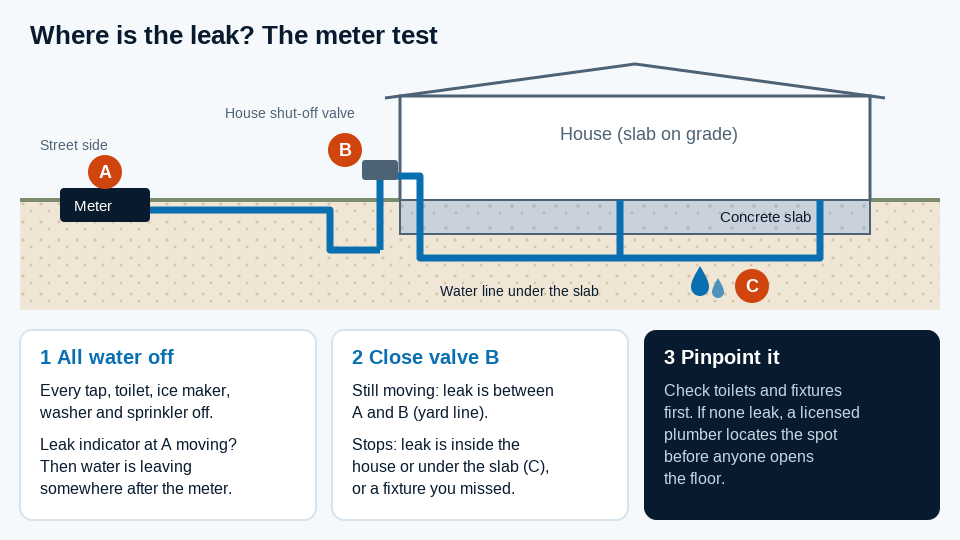
Illustration, not a photo of a real home. Letters match the steps below.
- Stop all water use. Turn off faucets, showers, the dishwasher, washing machine, ice maker, hose bibs and the irrigation system, and ask everyone in the house not to use water. The Southwest Florida Water Management District also says to let the water heater and ice maker finish refilling and a water softener finish regenerating first.
- Find the meter (A). It is usually in an in-ground box near the street or sidewalk. Lift the lid carefully (gloves help; insects and small animals like these boxes). If two meters share a box, the City of Tampa says to match the meter number to the one on your bill.
- Watch the leak indicator. On many meters it is a small red triangle or dial that spins when water flows. UF/IFAS Extension in Brevard County suggests watching for at least five minutes, because a leaking toilet may only run now and then. For a slow leak, write down the reading and check again later: the Southwest Florida Water Management District uses 30 minutes and EPA WaterSense two hours.
- If it moves, close the house shut-off valve (B) and watch again. Margate's utility explains how to read the result: if the indicator keeps moving with the house valve off, the leak is outside, between the meter and the house. If it stops, the leak is inside the house or in the pipes under it.
- Rule out the easy leaks. Toilets are a common hidden leak: put a few drops of food coloring in the tank and, if color shows in the bowl within an hour without flushing, the flapper is leaking (Margate). Also check the water heater relief valve line, the softener and outdoor faucets.
- Still a leak with the fixtures ruled out? That is the point to call a licensed plumber. Keep the main valve off between uses if water is reaching floors or walls.
Note: the meter only measures the supply side. A leaking drain or sewer line under the slab won't move the meter, so signs like a sewage smell, slow drains or damp floors near a bathroom still need a plumber even if the meter test is clean.
How a plumber usually finds the exact spot
The goal is to open as little floor as possible. A leak detection plumber will typically:
- Repeat the meter test and isolate the hot and cold sides, for example by closing the cold-water inlet at the water heater.
- Pressure-test individual lines to confirm which one is losing water.
- Pinpoint the spot with listening equipment (acoustic detection), and sometimes a thermal camera for hot-water lines.
- For drain lines, run a camera through the pipe from a cleanout to find breaks, roots or corroded sections.
- Explain the repair options and what each one means for your floors before work starts.
Repair options: spot repair, reroute or repipe
- Spot repair through the slab: the plumber cuts an access hole at the leak, repairs the pipe and the concrete is patched. It disturbs one area of flooring, which may be hard to match.
- Reroute (bypass): the leaking line is abandoned and a new line is run through the walls or attic. Floors usually stay intact; walls and ceilings need patching.
- Repipe: if the plumbing has had repeated leaks, replacing the supply lines may make more sense than chasing the next leak.
- Drain-line repair: broken or corroded drain lines under the slab may need the floor opened or a trenchless method, depending on the pipe and the damage.
Licensing and permits: in Florida, plumbing contractors are licensed through the Construction Industry Licensing Board under the Department of Business and Professional Regulation. A certified plumbing contractor can work statewide; a registered one only where the registration was issued. You can check a license by name or number on the DBPR license search at myfloridalicense.com. Repiping or replacing a water line usually needs a building permit. The City of Sarasota's water and sewer line replacement application, for example, requires a Notice of Commencement at $5,000 or more, allows emergency repairs to be permitted by the next business day, and has owner-builders acknowledge that "state law requires construction to be done by a licensed contractor." Rules vary by city and county, so ask the plumber who will pull the permit.
Drying the water damage
Fixing the pipe stops new water; it doesn't dry what is already wet. Water from a slab leak can wick into drywall and baseboards and sit under tile, wood and vinyl. EPA's mold remediation guidance sets out how to respond to water damage within 24 to 48 hours, and notes that even materials dried within 48 hours can still grow mold. A water extraction and structural drying company can measure moisture in the slab, walls and flooring and decide what can be dried in place and what has to come out. Wet wood floors have their own steps: see hardwood floor drying. If you already see or smell mold, read the mold remediation guide.
Insurance notes for Florida slab leaks
Coverage depends on your policy wording, so read it or ask your agent before assuming anything. A few points that come up often:
- The pipe, the access and the damage are often treated separately. Many homeowners policies treat the cost of repairing the leaking pipe itself, the cost of tearing out floor or slab to reach it, and the resulting water damage differently. Look for a water damage section or endorsement and any dollar sub-limit.
- Long-term leaks. Many policies exclude "constant or repeated seepage or leakage of water" over 14 days or more. In Hicks v. American Integrity (2018), a Florida appeals court found that wording ambiguous about the first 13 days of a leak, as Berger Singerman explains. In State Farm Florida v. Feltes (Sixth District Court of Appeal, November 27, 2024), the court held that the seepage exclusion barred coverage for tearing out the floor and foundation to reach a deteriorated cast iron drain line, and that a leak can be repeated rather than steady and still be excluded (Clausen Miller summary). Slab leaks are often slow, so these cases matter.
- Report it promptly and document it. Florida law (s. 627.70132) requires notice of a property insurance claim within one year after the date of loss, and of a supplemental claim within 18 months; your policy may also require prompt notice. Take photos and video, keep the plumber's leak report, and keep receipts for emergency drying.
- Mitigate. Policies generally expect you to take reasonable steps to stop further damage, such as shutting off the water and starting drying. Our Florida water damage insurance guide covers the claim process.
What affects the cost
We don't publish prices, because they vary by home and by company. These are the things that change the bill:
- How long the leak ran and how far water spread under flooring and into walls.
- Whether it is a supply line or a drain line, and the pipe material.
- The repair method: spot repair, reroute or repipe, and how much floor, wall or ceiling has to be opened and patched.
- Flooring type: tile, wood and vinyl that can't be matched may mean replacing a whole room.
- Drying time and equipment, and any mold work.
- Permits and inspections in your city or county.
The cost calculator can give you a rough starting range.
Common mistakes
- Running the meter test with the irrigation system, ice maker or softener still cycling, and getting a false alarm.
- Assuming a clean meter test rules out a drain-line leak.
- Opening tile or concrete to "look" before the leak is pinpointed.
- Drying only the surface: water under tile and inside walls needs moisture readings.
- Throwing away damaged flooring before it is photographed for the insurer.
- Waiting for the next water bill to see if the problem goes away.
When to stop troubleshooting and call
Call a plumber, and a water damage company if anything is wet, when the meter moves with all fixtures ruled out, when a floor is warm or wet with no visible source, when you smell sewage, or when tile is cracking or lifting.
Where we connect Florida homeowners
Independent companies in our network serve many parts of the state, including South Florida, Tampa Bay, Central Florida, Northeast Florida, Southwest Florida, Space and Treasure Coast, Florida Panhandle and the Florida Keys. Coverage depends on your ZIP code.
- Water damage help in Miami
- Water damage help in Tampa
- Water damage help in Orlando
- Water damage help in Jacksonville
- Water damage help in Fort Lauderdale
- Water damage help in St. Petersburg
- Water damage help in Naples
- Water damage help in Fort Myers
- Water damage help in Sarasota
- Water damage help in West Palm Beach
- Water damage help in Tallahassee
- Water damage help in Pensacola
Slab leak questions
How do I check for a slab leak?
Turn off all water use, including the ice maker, washer and irrigation, then watch the leak indicator on your water meter for at least five minutes. For a slow leak, note the reading and check it again after 30 minutes or more. If it moves, close the house shut-off valve: if the indicator stops, the leak is inside the house or in the pipes under it; if it keeps moving, the leak is between the meter and the house.
Do they have to break up my floor?
Not always. Many leaks are fixed by rerouting the pipe through walls or the attic instead of digging through the slab. A plumber should pinpoint the leak and explain the options before any floor is opened.
Can a slab leak be in a drain line?
Yes. Drain and sewer lines also run under the slab. The water meter only measures the supply side, so a drain leak won't show on the meter test. Sewage smells, slow drains or damp floors near a bathroom are reasons to have a plumber run a camera through the drain line.
Does homeowners insurance cover a slab leak in Florida?
It depends on your policy. Many policies treat the leaking pipe, the cost of tearing out floor or slab to reach it, and the resulting water damage differently, and many exclude leaks that continued for 14 days or more. Florida courts have read that exclusion in different ways (Hicks, 2018; Feltes, 2024). Read your policy, document the damage and report the claim promptly.
How quickly should a slab leak be dealt with?
As soon as you confirm it. Keep the main valve off when water is reaching floors or walls, and start drying quickly: EPA guidance is built around responding to water damage within 24 to 48 hours to limit mold, and long-running leaks can also fall under insurance exclusions.
Who should I call first, a plumber or a water damage company?
A licensed plumber finds and repairs the leak. If floors, baseboards or walls are already wet, a water damage restoration company measures moisture and dries the structure. Both can be arranged the same day; our line can connect you with a local restoration company.
How does this service work?
We're a referral service. Your call goes to an independent provider serving your area, sometimes through a call partner, and we may be paid for the referral. You agree on the work and price directly with the provider.
Who will come to my home?
An independent, local water damage restoration or plumbing company that serves your area. Ask them about their Florida licensing, insurance and certifications (such as IICRC) when you talk.
Do you do the restoration work yourselves?
No. We don't employ crews or own equipment. We connect you with independent local companies.
Related guides
- Burst pipe: first steps and drying
- Find and test your water shut-off valve
- Water heater leaking
- Water damage emergency steps
- Does insurance cover water damage in Florida?
Sources
- UF/IFAS Extension Brevard County, How to check your water meter to find hidden leaks (May 29, 2018): blogs.ifas.ufl.edu
- Southwest Florida Water Management District, Seek the leak indoors (undated): swfwmd.state.fl.us
- City of Tampa Water, Fix a leak (updated October 9, 2026): tampa.gov
- City of Margate, Leak detection (undated): margatefl.com
- Seminole County, Leaks (undated): seminolecountyfl.gov
- U.S. EPA WaterSense, Fix a Leak (archived January 19, 2017 snapshot): epa.gov
- U.S. EPA, Mold Remediation in Schools and Commercial Buildings, chapter 4: epa.gov
- City of Sarasota, Sewer and waterline replacement permit application (updated November 2023): sarasotafl.gov (PDF)
- Housecall Pro, Plumbing license requirements in Florida (updated January 31, 2024; third-party summary of DBPR rules): housecallpro.com
- Florida Statutes s. 627.70132 (2025): flsenate.gov
- Berger Singerman, Hicks v. American Integrity (February 28, 2018): bergersingerman.com
- Clausen Miller, State Farm Fla. Ins. Co. v. Feltes, 6D2023-0991 (December 10, 2024): clausen.com
Sources were checked on November 6, 2026. Last updated November 6, 2026. This page is general information, not legal or insurance advice.
Slab leak soaking your floors?
Call now. We'll connect you with a local Florida company that can help.