Water heater leaking? What to do in Florida
How to make a leaking water heater safe, find where the water is coming from, and decide between a repair, a replacement and a drying company. A 24/7 line can connect you with a local company.
Water around the base of a water heater, a drip from the pipe on its side or a wet garage floor needs quick, careful action. This guide shows how to make the heater safe, find where the water is coming from, what you can check yourself and when a plumber or a water damage company should take over. If water is already spreading into rooms, you can call our 24/7 line to be connected with an independent local company.
Safety first
- Gas heater and you smell gas: don't touch switches or the heater. Leave the house first. Peoples Gas tells customers who suspect a leak to leave the area and call 911, then call the utility at 877-832-6747 (Peoples Gas safety). If your gas comes from another utility or a propane company, use their emergency number.
- Water near the electrical connection or the outlet behind the heater: don't reach into the water. Switch off the heater's breaker at the panel only if you can reach it while standing somewhere dry.
- Hot water: the tank and the water coming out of it can scald. The U.S. Consumer Product Safety Commission says water at 140°F can burn in about six seconds and asks households to set water heaters to 120°F (CPSC, Tap Water Scalds, publication 5098). Let the water cool before you open the drain valve.
- Steam, hissing or water spraying from the relief valve: stay back, shut off the power or gas and the cold-water supply if you can do it safely, and call a plumber. That valve opens when temperature or pressure is too high.
- Flooded heater: if the heater itself has been standing in floodwater, don't restart it. A. O. Smith's owner's manual says a water heater that has been subject to flooding must be replaced (A. O. Smith residential electric water heater owner's manual).
What to do in the first 15 minutes
- Turn off the energy. For an electric heater, switch off its breaker. For a gas heater, turn the gas control to "off" or "pilot" as the label on the heater shows, or close the gas valve on the supply line.
- Close the cold-water valve on the pipe that feeds the top of the heater. If it won't turn or the leak continues, close the main valve for the house. Our water shut-off valve guide shows where to find both in a house or condo.
- Protect the area. Move boxes, rugs and anything stored next to the heater. In a garage, sweep water toward the door; in a closet or utility room, put down towels and start pulling water away from walls and flooring.
- Take photos and video of the heater, its label, the water on the floor and anything damaged before you clean up. They help with any insurance claim.
- Start drying quickly. EPA cleanup guidance is built around drying wet materials within 24 to 48 hours to prevent mold growth (EPA mold remediation guide, chapter 4). If water has reached drywall, baseboards, carpet or wood flooring, a water extraction and structural drying company can measure moisture and dry what's hidden.
Find where the water is coming from
Dry the outside of the heater and the floor around it, then watch where fresh water appears. Water runs down the side of the tank, so a puddle at the bottom doesn't always mean the bottom is leaking.
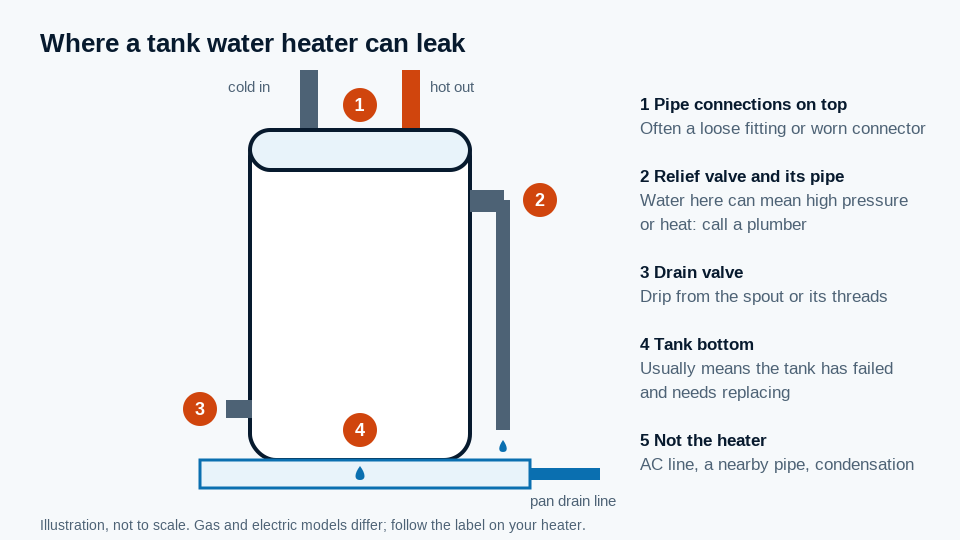
Illustration, not a photo of a real home. Numbers match the list below.
- Top of the heater, at the pipes (1): a loose fitting, a worn flexible connector or a corroded nipple. These are often repairable, but the work is for a plumber.
- The pipe on the side that runs down toward the floor (2): that's the discharge pipe of the temperature and pressure (T&P) relief valve. Water from it means the valve opened or is failing. A Star Tribune home-inspection column explains that the valve will leak if system pressure exceeds 150 psi, and that a valve which keeps leaking after it's replaced points to a pressure problem worth checking with a gauge (Star Tribune). Never cap or plug this pipe: the manufacturer's manual says not to plug the relief valve or the end of its drain line.
- The drain valve near the bottom (3): a drip from the spout or its threads. Check that it's fully closed; if it still drips, a plumber can replace it.
- The bottom of the tank itself (4): water seeping from under the jacket or rust at the base usually means the inner tank has corroded through. A tank leak can't be patched reliably; plan on replacing the heater.
- Not the heater at all (5): in Florida, water heaters often share a closet or garage wall with the AC air handler. A clogged condensate line, a nearby supply pipe or condensation on cold pipes can drip onto the same floor. See our AC drain overflow guide if the water is near the air handler.
How old is the heater?
Age is a strong clue. The U.S. Department of Energy lists conventional storage water heaters as lasting 10 to 15 years, tankless models about 20 years and heat pump water heaters about 10 to 15 years (Energy Saver, February 28, 2022). The home-inspection association InterNACHI puts the typical lifespan at about 10 years and notes that installation, water use, construction and maintenance all change it (InterNACHI). The manufacture date is usually coded in the serial number on the label; the manufacturer or a plumber can decode it. An older tank that leaks from the body is almost always a replacement, not a repair.
Florida specifics
- Where the heater sits matters. Many Florida homes are built on slabs with the heater in the garage, an interior closet or a utility room next to living space. A leak in an interior closet can wick into drywall, baseboards and flooring in neighboring rooms within hours, so look beyond the closet.
- Drain pans. The City of Fort Walton Beach's building FAQ says a drip pan is required when the heater is in living space, or in a non-living space such as a garage on the same floor level as living space, and recommended (not required) when it sits on a floor below the living area (Fort Walton Beach water heater FAQs). Rules are applied locally, so ask your plumber or building department. A pan helps only if its drain line is clear and goes somewhere safe.
- Permits. The same FAQ says replacing a water heater needs a permit, so the installation can be checked against the Florida Building Code. Other counties and cities set their own permit rules; a licensed plumber normally pulls the permit.
- Condos. In a condo, a water heater leak often reaches the unit below. Tell your association or manager right away, and see the condo notes in our Florida water damage insurance guide.
What you can do yourself, and what needs a professional
Reasonable for a homeowner
- Turning off the breaker or gas control and closing the cold-water valve.
- Moving belongings, mopping and running fans in the area.
- Closing a dripping drain valve that wasn't fully shut.
- Checking whether the water is really coming from the heater, using the list above.
Call a professional for
- Repairs or replacement: a licensed plumber. Gas connections, venting, relief valves and pressure problems are not DIY jobs. Ask for their Florida license number and whether they'll pull the permit.
- Wet drywall, baseboards, cabinets or flooring: a water damage restoration company with moisture meters and drying equipment.
- Musty smell or visible growth: see our mold remediation guide.
Common mistakes
- Capping or plugging the relief valve pipe to stop the drip. The valve exists to release dangerous pressure and heat.
- Draining a hot tank straight away. Let it cool first, and run the drain hose to a floor drain or outdoors.
- Waiting to see if it gets worse. A slow leak can rot a closet floor and wall over weeks, and many Florida homeowners policies have an exclusion for constant or repeated leakage over 14 days or more (see insurance notes below).
When to stop troubleshooting
Stop and call for help if you smell gas, water is near electrical parts, the relief valve is releasing steam or hot water, the tank itself is leaking, water has spread past the closet or garage, or you can't find the source after drying everything and watching.
Insurance notes for Florida
Coverage depends on your policy and on what caused the leak. Kin Insurance's guide says homeowners insurance probably won't pay to repair or replace a heater that simply wore out or malfunctioned, but may cover damage to the home from a sudden leak if the cause is a covered peril; equipment breakdown coverage is a separate add-on (Kin, updated July 27, 2026). Many Florida policies exclude damage from constant or repeated leakage over 14 days or more. In Hicks v. American Integrity (2018), a Florida appeals court found that wording ambiguous as applied to the first 13 days of a leak (Berger Singerman, February 28, 2018). Report the damage promptly, keep receipts for emergency repairs and keep your photos. Our insurance guide covers Florida's claim notice deadlines. We can't tell you whether a claim will be paid.
What affects the cost
We don't quote prices, and the independent companies you reach set their own. The main factors are whether the heater is repaired or replaced, gas vs. electric vs. tankless, permit and code updates (for example a pan or expansion tank), how far the water spread, which materials got wet (drywall, baseboards, cabinets, wood or laminate floors), how long they stayed wet and whether mold has started. Our cost calculator gives a rough range for the water damage side.
Water heater leak questions
Is a leaking water heater an emergency?
It can be. Shut off the power or gas and the cold-water supply right away. If you smell gas, leave and call 911 and your gas utility. A small drip at a fitting can wait for a plumber; water spreading into rooms needs drying within a day or two.
Why is water coming out of the pipe on the side of my water heater?
That pipe drains the temperature and pressure relief valve. Water from it means the valve opened because of high pressure or heat, or the valve is failing. Don't cap it. Turn off the energy and have a plumber check the valve and your water pressure.
Can a leaking water heater tank be repaired?
Leaks at the pipe connections, drain valve or relief valve can often be repaired. A leak from the tank body usually means the inner tank has corroded through, and the heater needs to be replaced.
Does homeowners insurance cover a leaking water heater?
It depends on the policy. Insurers often don't pay for a heater that wore out, but may cover sudden water damage to the home from a covered cause. Many Florida policies exclude leaks that went on for 14 days or more. Report damage promptly and keep photos and receipts.
Do I need a permit to replace a water heater in Florida?
Often, yes. The City of Fort Walton Beach, for example, requires a permit for water heater replacement. Rules vary by city and county; a licensed plumber normally pulls the permit.
Should my water heater have a drain pan?
Usually, if it's inside living space or in a garage on the same level. Fort Walton Beach requires one in those locations. The pan needs a clear drain line to a safe place to be useful.
How does this service work?
We're a referral service. Your call goes to an independent provider serving your area, sometimes through a call partner, and we may be paid for the referral. You agree on the work and price directly with the provider.
Who will come to my home?
An independent, local water damage restoration or plumbing company that serves your area. Ask them about their Florida licensing, insurance and certifications (such as IICRC) when you talk.
Do you do the restoration work yourselves?
No. We don't employ crews or own equipment. We connect you with independent local companies.
Related guides
- Water damage emergency steps by water source
- Burst pipe and plumbing leak guide
- Washing machine and appliance leaks
- Ceiling water damage: find the source
Where we connect Florida homeowners
Independent companies in our network serve many parts of the state, including South Florida, Tampa Bay, Central Florida, Northeast Florida, Southwest Florida, Space and Treasure Coast, Florida Panhandle, Florida Keys. Coverage depends on your ZIP code.
- Water damage help in Miami
- Water damage help in Tampa
- Water damage help in Orlando
- Water damage help in Jacksonville
- Water damage help in Fort Lauderdale
- Water damage help in St. Petersburg
- Water damage help in Naples
- Water damage help in Fort Myers
- Water damage help in Sarasota
- Water damage help in West Palm Beach
- Water damage help in Tallahassee
- Water damage help in Pensacola
Sources were checked on November 4, 2026. Last updated November 4, 2026.
Water heater leak spreading?
Call now. We'll connect you with a local Florida company that can help.