Water damage restoration in Florida
What happens at each stage after a leak or flood, how the type of water changes the job, and the Florida license, insurance and contract rules to know. A 24/7 line can connect you with a local company.
Water damage restoration returns a wet home to normal. It covers stopping the water, removing what is standing, drying the structure, cleaning, and repairing what had to be removed. In Florida's heat and humidity mold can start quickly, so the first two days matter most. This guide explains each stage, how the type of water changes the job, what Florida law says about licenses, contracts and insurance, and what to ask before you sign anything.
In the first hour
- Stop the water at the fixture valve or the main shut-off. Our shut-off valve guide shows where to look in a house or condo.
- Stay away from electricity and sagging ceilings. Don't walk through water near outlets or plugged-in appliances, and keep out from under a bulging ceiling.
- Treat sewage and outside floodwater as contaminated. Keep children and pets away and don't try to clean it up with household tools.
- Photograph everything before anything is moved or thrown away, including serial numbers on damaged appliances.
- Start drying or get help started. If the water is more than a small, clean spill, call a restoration company the same day. Step-by-step help by water source is in our emergency steps guide.
Mitigation, restoration, remediation: what the words mean
You'll hear these words from companies and adjusters, and on estimates they are often separate line items:
- Mitigation is the emergency part: stopping the water, extracting it, removing materials that can't be saved and drying the structure so the damage stops spreading.
- Restoration is putting the home back: new drywall, paint, trim, cabinets and flooring once everything is dry.
- Remediation usually means removing mold or contamination. In Florida, mold assessment and remediation are licensed activities; see our mold remediation guide.
The restoration process, stage by stage
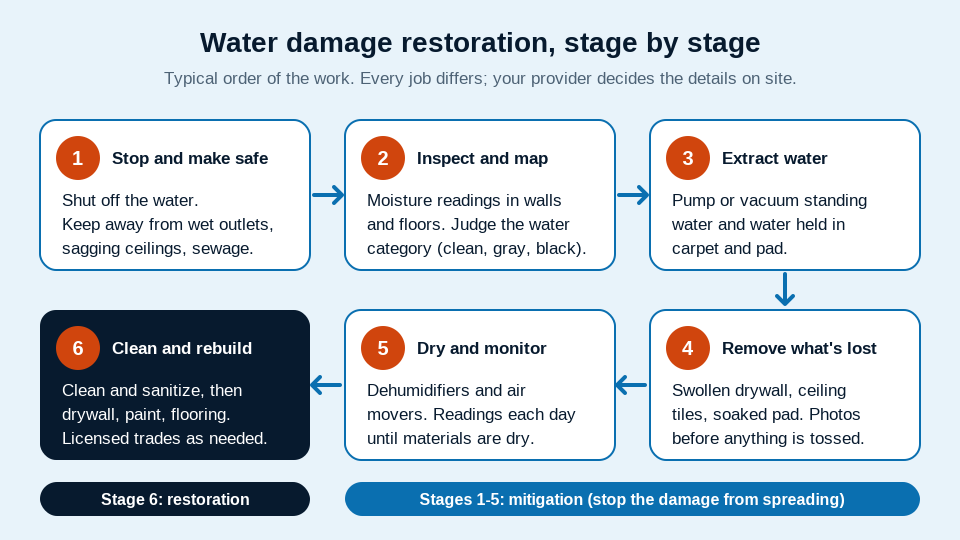
Illustration of a typical order of work, not a photo of a real job. The first five stages are mitigation; the last is restoration.
- Stop the source and make it safe. The plumbing leak, AC drain or appliance is shut off or repaired first. If the cause is a broken pipe, a licensed plumber fixes it; see burst pipe and plumbing leaks.
- Inspect and map the moisture. Water travels under flooring, into wall cavities and along framing, so a good inspection uses moisture meters (and often a thermal camera) to find where it went, not just where it shows. This is also when the company judges the category of the water (below), which decides how much has to be removed.
- Extract standing water. Pumps and truck-mounted or portable extractors remove water from floors, carpet and pad. Getting the bulk of the water out first makes drying much faster. More detail: emergency water extraction.
- Remove what can't be saved. Soaked padding, swollen drywall and wet ceiling tiles usually come out. Ask the company to photograph and list what they remove before it leaves the house; your insurer may want to see it.
- Dry and monitor. Dehumidifiers and air movers run until the materials reach a dry reading. Ask for a written drying log with daily moisture readings: it shows when drying is actually done and supports an insurance claim. More detail: structural drying and wet hardwood floor drying.
- Clean, then rebuild. Surfaces are cleaned (and sanitized after contaminated water), then drywall, paint, cabinets and flooring are replaced. Rebuild work that involves plumbing, electrical or structural changes needs licensed contractors and may need a permit from your city or county.
Clean, gray or black water: why the category matters
Restoration companies classify water using the IICRC S500 standard. In short:
- Category 1 comes from a sanitary source, such as a broken supply line.
- Category 2 contains significant contamination and could make people sick.
- Category 3 is grossly contaminated and can contain pathogens; the standard's examples include sewage, seawater flooding and rising river or stream water (R&R magazine on the S500 categories).
Two points that often surprise homeowners:
- The category can get worse with time. Clean water that sits for days in warm conditions, picking up dirt and building materials, can degrade to Category 2 or 3. That is one more reason to start quickly in Florida.
- Not all rain or weather water is automatically Category 3. In a February 10, 2026 position statement, the IICRC said water from weather-related events and wind-driven rain is not automatically Category 3; the restorer should inspect and decide based on whether the water is grossly contaminated (IICRC position statement). Ask the company to explain the category it assigned and why, because it changes what gets thrown away.
For sewage, see our sewage backup cleanup guide; for outside water, flood damage restoration.
What can usually be dried, and what usually goes
The EPA's cleanup table is built around responding within 24 to 48 hours. Its guidance for common materials (EPA mold remediation guide, chapter 4, table 1):
- Carpet and backing: dry within 24 to 48 hours by extracting water and running dehumidifiers and fans; the subfloor underneath must be cleaned and dried too.
- Drywall: may be dried in place if there is no obvious swelling and the seams are intact; otherwise remove and replace it.
- Ceiling tiles: discard and replace.
- Wood floors: remove moisture immediately with dehumidifiers, gentle heat and fans (be careful with heat on hardwood).
- Upholstered furniture: may be hard to dry completely within 48 hours; consider a specialist for valuable pieces.
If materials stayed wet longer than 48 hours or mold is already visible, the EPA points to its separate mold-remediation guidance, and the job becomes a mold job as well as a drying job. These are the EPA's guidelines for clean-water situations; contaminated water (Category 2 or 3) usually means more has to be removed.
Licenses: who does what in Florida
- Drying and dehumidifying. In October 2024 Florida's Third District Court of Appeal held, in a case about condominium mitigation work after Hurricane Irma, that water damage mitigation and dehumidification did not require a building contractor's license, while structural removal of materials such as drywall might (Adams and Reese, Oct. 29, 2024). Courts have disagreed on this, so ask any company what licenses it holds and which parts of the job it will subcontract.
- Plumbing, electrical and rebuild work generally require state-licensed contractors. The Florida Department of Business and Professional Regulation (DBPR) says to always verify licenses before hiring, on its website, by phone at (850) 487-1395 or in its mobile app, and to report unlicensed activity to its hotline at (866) 532-1440 (DBPR consumer advisory).
- Mold assessment and remediation have their own state license; see our mold guide.
- Certifications such as IICRC training are private credentials, not state licenses. They are worth asking about, along with proof of insurance.
Insurance and contracts: Florida rules to know
- Report the claim promptly. Under s. 627.70132, Florida Statutes, notice of a new or reopened property claim must be given within 1 year of the date of loss, and a supplemental claim within 18 months (Fla. Stat. 627.70132). Earlier is better: it is easier to show what happened while the damage is fresh.
- Assignment of benefits (AOB) is banned on newer policies. For residential policies issued on or after January 1, 2023, a policyholder may not assign post-loss benefits, and an attempt to do so is void and unenforceable (Fla. Stat. 627.7152(13)). Be wary of paperwork that asks you to hand your claim to a contractor; read anything you sign, and ask who is responsible for paying if the insurer pays less than the estimate.
- Check for a managed repair or contractor network program. Some Florida insurers offer their own repair networks and limit coverage if you don't use them. For example, a 2019 Citizens Property Insurance brochure described a $10,000 sublimit for permanent repairs and a $3,000 limit for emergency mitigation by your own contractor on non-weather water claims when its program is declined (Citizens Managed Repair Program brochure, 09/2019). Programs and limits change, so read your current policy or call your insurer before you hire.
- Protect the property. Most homeowners policies expect you to take reasonable steps to prevent further damage, such as stopping the water and drying. Keep receipts for emergency work.
- Plumbing leak vs. flood. Homeowners policies and flood insurance cover different things: outside rising water is generally a flood-policy matter. Our Florida insurance claim guide explains sudden vs. gradual leaks and flood coverage.
Questions to ask before you sign
- What licenses do you hold in Florida, and who will do the drywall, plumbing or electrical work?
- Can I see proof of general liability insurance?
- What category of water is this, and what do you plan to remove because of it?
- Will you give me a written estimate, photos and a daily drying log?
- Does the contract include an assignment of benefits or direction to pay? What do I owe if my insurer doesn't pay the full amount?
- Do you need a permit for any of the repairs, and who pulls it?
What affects the cost
We don't publish prices because they vary by job and provider. The main cost factors are:
- Area and depth of the water, and how many rooms or floors it reached.
- Water category: contaminated water means more removal, cleaning and protective measures.
- Time before drying started, and whether mold has begun to grow.
- Materials affected: hardwood, cabinets, plaster or multiple layers of flooring take longer.
- Equipment days: how long dehumidifiers and air movers run.
- Rebuild scope and any permits needed.
- Access: condos, crawl spaces and after-hours calls can add time.
For a rough idea of scope, try our cost and drying calculator.
Signs you need help
- Standing water on floors
- Soft, stained or bubbling drywall
- Musty smell
- Warped floors or swollen baseboards
- A stain on the ceiling that keeps growing; see ceiling water damage
Where we connect Florida homeowners
Independent companies in our network serve every part of the state, including South Florida, Tampa Bay, Central Florida, Northeast Florida, Southwest Florida, Space and Treasure Coast, Florida Panhandle, Florida Keys.
- Water damage help in Miami
- Water damage help in Tampa
- Water damage help in Orlando
- Water damage help in Jacksonville
- Water damage help in Fort Lauderdale
- Water damage help in St. Petersburg
- Water damage help in Naples
- Water damage help in Fort Myers
- Water damage help in Sarasota
- Water damage help in West Palm Beach
- Water damage help in Tallahassee
- Water damage help in Pensacola
Water damage restoration questions
How long does water damage restoration take?
Drying alone often takes several days. It depends on the materials, the water category and how quickly drying started; a daily drying log with moisture readings shows when it is done. Repairs afterward can take from a few days to several weeks, depending on what had to be removed.
What is the difference between water mitigation and water damage restoration?
Mitigation is the emergency work that stops damage from spreading: stopping the water, extracting it, removing materials that can't be saved and drying the structure. Restoration is the rebuild afterward: drywall, paint, cabinets and flooring. Estimates and insurance claims often list them separately.
Does Florida homeowners insurance cover water damage?
Many policies cover sudden and accidental water damage, such as a burst supply line. Gradual leaks and outside flooding are often excluded or need a separate flood policy. Check your policy, report the claim promptly (Florida law sets a 1-year deadline for new claims), and see our insurance claim guide.
Can I sign my insurance benefits over to the restoration company in Florida?
Not on newer policies. Under s. 627.7152(13), Florida Statutes, post-loss benefits under residential property policies issued on or after January 1, 2023 can't be assigned, and an attempt to do so is void. Read any contract carefully and ask what you owe if the insurer pays less than the estimate.
Does a water mitigation company need a license in Florida?
Plumbing, electrical and rebuild work generally need state-licensed contractors, and mold remediation has its own license. For drying and dehumidifying alone, a 2024 Third District Court of Appeal decision held that a building contractor's license wasn't required, though removing drywall might be different and courts have disagreed. Ask which licenses the company holds and verify them with DBPR.
Is all rain or flood water treated as black water?
No. Sewage, seawater and rising river or stream water are classic Category 3 (black water) examples. In a February 2026 position statement, the IICRC said weather-related water is not automatically Category 3; the restorer should inspect and decide based on contamination. Ask the company to explain the category it assigns.
Can wet drywall be saved?
Sometimes. EPA guidance says drywall wet with clean water may be dried in place if there is no obvious swelling and the seams are intact, ideally within 24 to 48 hours; otherwise it should be removed and replaced. Drywall soaked by sewage or floodwater is usually removed.
How does this service work?
We're a referral service. Your call goes to an independent provider serving your area, sometimes through a call partner, and we may be paid for the referral. You agree on the work and price directly with the provider.
Who will come to my home?
An independent, local water damage restoration or plumbing company that serves your area. Ask them about their Florida licensing, insurance and certifications (such as IICRC) when you talk.
Do you do the restoration work yourselves?
No. We don't employ crews or own equipment. We connect you with independent local companies.
Sources
- IICRC, Weather-Related Water Damage position statement, Feb. 10, 2026
- R&R magazine, "The Standards of Our Time: Applying IICRC Categories of Water", Mar. 1, 2007
- U.S. EPA, Mold Remediation in Schools and Commercial Buildings, chapter 4, table 1 (undated web page)
- Adams and Reese, "Florida Courts Disagree on Disaster Recovery License Requirements", Oct. 29, 2024
- Florida DBPR consumer advisory on unlicensed contractors, Mar. 15, 2016
- Fla. Stat. 627.70132 (2025) and 627.7152 (2023), Florida Senate
- Citizens Property Insurance, Managed Repair Program brochure, 09/2019
Sources were checked on October 30, 2026. Last updated October 30, 2026. This page is general information, not legal or insurance advice.
Get water damage restoration help now.
Call now. We'll connect you with a local Florida company that can help.